For screen readers and other accessibility features, the infographic below is available to download as a fully tagged PDF:
About this study
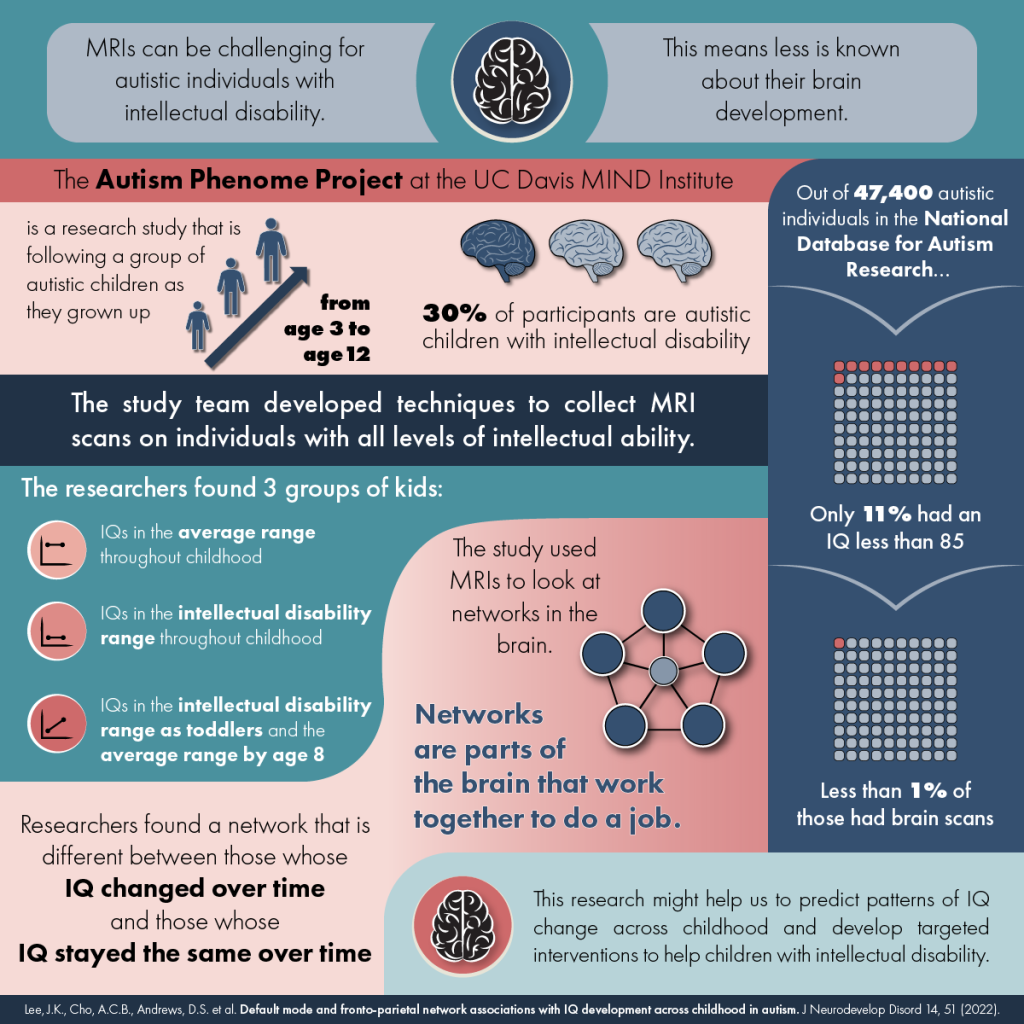
MRI is an important tool for studying brain development in autistic individuals. In as little as 10 minutes, an MRI scan can provide a highly detailed picture of the brain that reveals many different aspects of brain structure and function. The main challenge with MRI scans is that those scanned must lie almost perfectly still in a small and very noisy space. Because of this, autistic individuals with intellectual disability are often excluded from MRI studies. This is a problem because about one third of autistic individuals have an intellectual disability (IQs < 70), and they are sorely under-represented in research studies. A 2016 survey of the National Database for Autism Research found that out of 47,400 participants with autism, only 11% had IQs less than 85 and <1% of these had neuroimaging data available.
Because of this, very little is known about how brain development differs between autistic individuals with and without intellectual disability. Identifying brain differences between these groups could be useful in helping us to better understand autism, in predicting outcomes and in guiding the selection of appropriate supports. The UC Davis MIND Institute Autism Phenome Project (APP) is a longitudinal study that that has been following a cohort of autistic children from 3 years of age through late adolescence (age 18). Importantly, we have developed strategies to collect MRI scans individuals at all levels of intellectual ability; 30% of the APP cohort is comprised of autistic children with intellectual disability. This enables us to investigate associations between their brain and intellectual development.
Building upon what we have learned from two behavioral studies about the paths of intellectual development, we recently evaluated brain networks associated with these trajectories. The behavioral work had identified three trajectory-based subgroups: one with IQs in the neurotypical range across childhood, a second with IQs in the intellectual disability range across childhood, and a third with IQs in the intellectual disability range in early childhood who made significant gains across childhood. By the time those in this third group were 8 years old, their IQs were no longer in the intellectual disability range. We called this group the ‘Changers.’
We investigated whether there were brain differences between the Changers and the group with persistent intellectual disability. Using MRI scans collected at 3 years of age, we investigated the frontoparietal and default mode networks — two brain networks associated with intellectual functioning. We found that the frontoparietal network was associated with current IQ – that is, the groups with intellectual disability at age 3 (the Changers and individuals with intellectual disability) differed from the group with IQs in neurotypical in several regions of the frontal parietal network. In contrast, the default mode network differed between the Changers group and the other two groups, suggesting that this network may be involved in mechanisms related to improving intellectual function. These findings provide initial clues about how the brain differs between autistic individuals with and without intellectual disability during early childhood and how these differences might predict future intellectual ability. Furthermore, the findings might help to better identify those more likely to experience persistent intellectually disability and to develop interventions that help them.
Learn more
This pair of studies identifies subsets of autistic children based on developmental trajectories of IQ and associations with two brain networks. Read more about these studies:
- Default Mode and Fronto-Parietal Network Associations with IQ Development Across Childhood in Autism, Journal of Neurodevelopmental Disorders. Sept 2022, Lee JK, Cho AC, Andrews DS, Ozonoff S, Rogers SJ, Amaral DG, Solomon M, Nordahl CW.
- IQ trajectories in autistic children through preadolescence, JCPP Advances, March 2023 Solomon M, Cho A-C, Iosif A-M, Heath B, Srivastav A, Nordahl CW, Ferrer E, Amaral DG