Skip to content

Nordahl Lab

Neuroimaging of development in autism | UC Davis MIND Institute

Menu
  • Home
  • Team
    • Faculty
    • Staff
    • Study Coordinators
    • Trainees
  • Studies
  • Publications & Findings
  • Presentations
    • About Dr. Nordahl
    • Autism in girls and women
    • Autism Phenome Project – autism subgroups
    • Gender Diversity in Autism
    • Respectful Language in Autism Research
  • Resources for Families
  • NeuroTeens

Featured Publications

Infographic summarizing findings from zebrafish study. Section 1: There are many genes related to autism. The diversity in autism traits from person to person can make it hard to study, but we can focus on those who share a common trait. Section 2: Disproportionate megalencephaly (big brain, larger than is typical compared to the rest of the body) occurs in 15% of autistic boys. They're more likely to have intellectual disability and fewer language gains over time. Section 3: We looked at the genes of over 100 autistic children with big brains and their parents. We found new gene changes in the children that weren't in their parents. Section 4: Zebrafish share over 70% of the same genes as humans. In zebrafish, we can "edit" genes. This makes them very helpful to learn what certain genes do. We changed the genes to mimic the changes we saw in autistic children with big brains. Then, we measured the size of the zebrafish brains. Section 5: We found a gene called YTHDF2 that impacted brain size. More of this gene results in bigger zebrafish brains. Less of this gene resulted in smaller brains. Section 6: This study showed us how zebrafish can help us understand what different genes do and how they affect the brain. We have many more genes to study. We are excited to learn more about how these genes relate to autism and brain development.
Featured Publications / Publications

Autism, Big Brains, and Zebrafish?

Autism is a complex neurodevelopmental condition commonly associated with difficulties or differences in communication, social interactions, and repetitive behaviors. Researchers have found that autism is largely influenced by mutations in …

Featured Publications / Publications

Looking at gastrointestinal symptoms in autistic children over time

Children with autism have been found to experience more medical issues including gastrointestinal symptoms. In this study, participants in the autism group were more likely to experience gastrointestinal symptoms than …

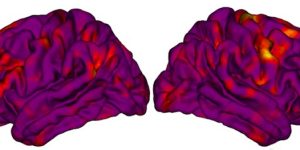
Brain viewed from 2 sides. The brain is shaded dark purple with red and yellow highlights in certain regions.
Featured Publications / In the news / Publications

Sex differences in trajectories of cortical development in autistic children from 2–13 years of age

Learn more about the article from the MIND Institute press release: Researchers find key differences in brain development between autistic boys and girls The full article is published in Nature.

Logo with GAIN written in blue block letters. The A is stylized with an arrow pointing upwards Text at the bottom reads: Girls with Autism - Imaging of Neurodevelopment
Featured Publications / Publications

Why do we need sex-balanced studies of autism?

Males are diagnosed with autism much more frequently than females, and most research study samples reflect this male predominance. The result is that autistic females are understudied. There is a …

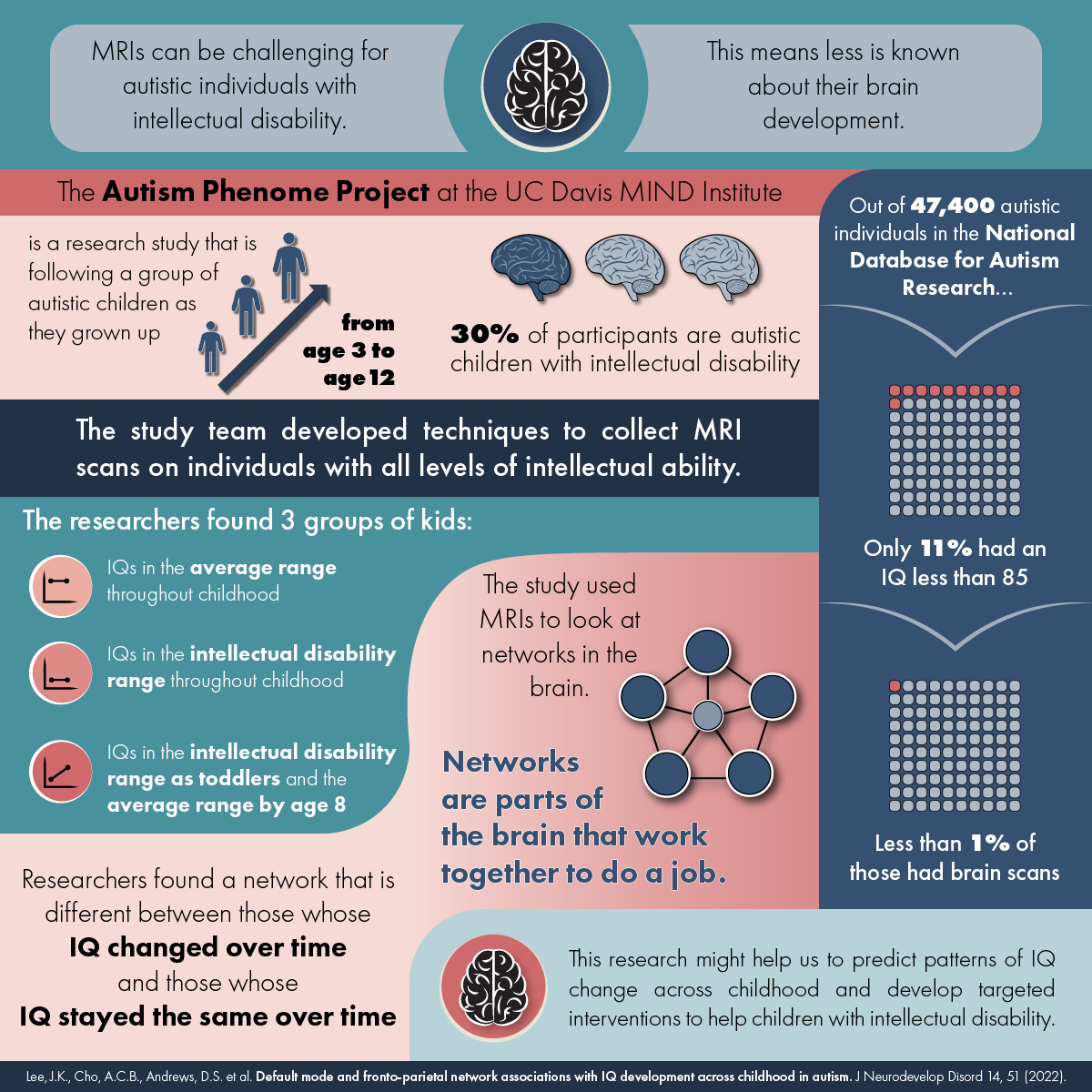
Infographic for the IQ trajectories article. Section 1: MRIs can be challenging for autistic individuals with intellectual disability. This means less is known about their brain development. Section 2: Out of 47,400 autistic individuals in the National Database for Autism Research, only 11% had an IQ less than 85. Less than 1% of those had brain scans. Section 3: The Autism Phenome Project at the UC Davis MIND Institute is a research study that is following a group of autistic children as they grown up from age 3 to age 12 30% of participants are autistic children with intellectual disability. The study team developed techniques to collect MRI scans on individuals with all levels of intellectual ability. Section 4: The researchers found 3 groups of kids: IQs in the average range throughout childhood. IQs in the intellectual disability range throughout childhood. IQs in the intellectual disability range as toddlers and the average range by age 8. Section 5: The study used MRIs to look at networks in the brain. Networks are parts of the brain that work together to do a job. Researchers found a network that is different between those whose IQ changed over time and those whose IQ stayed the same over time. Section 6: This research might help us to predict patterns of IQ change across childhood and develop targeted interventions to help children with intellectual disability.
Featured Publications / Publications

IQ trajectories in autistic children through preadolescence

The study team developed techniques to collect MRI scans on individuals with all levels of intellectual ability. We found a brain network that is different between children whose IQ changed over time and those whose IQ stayed the same over time.

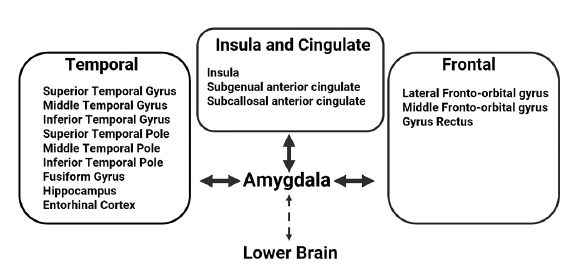
A text-based graphic describing brain connections. At the center is "Amygdala." Small arrows connect that to "Lower Brain." Larger areas connect Amgydala to 3 boxes. Box 1: Temporal (includes superior temporal gyrus, middle temporal gyrus, inferior temporal gyrus, superior temporal pole, middle temporal pole, fusiform gyrus, hippocampus, and entorhinal cortex. Box 2: Insula and Cingulate (includes insula, subgenual anterior cingulate, and subcallosal anterior cingulate). Box 3: Frontal (includes lateral-fronto-orbital gyrus, middle-fronto-orbital gyrus, and gyrus rectus).
Featured Publications / Publications

Sex differences in areas of the brain connected to the amygdala

This study found sex differences between the network of regions that are monosynaptically connected to the amygdala.

Featured Publications / Publications

Differences in brain networks in 3-year-old autistic children

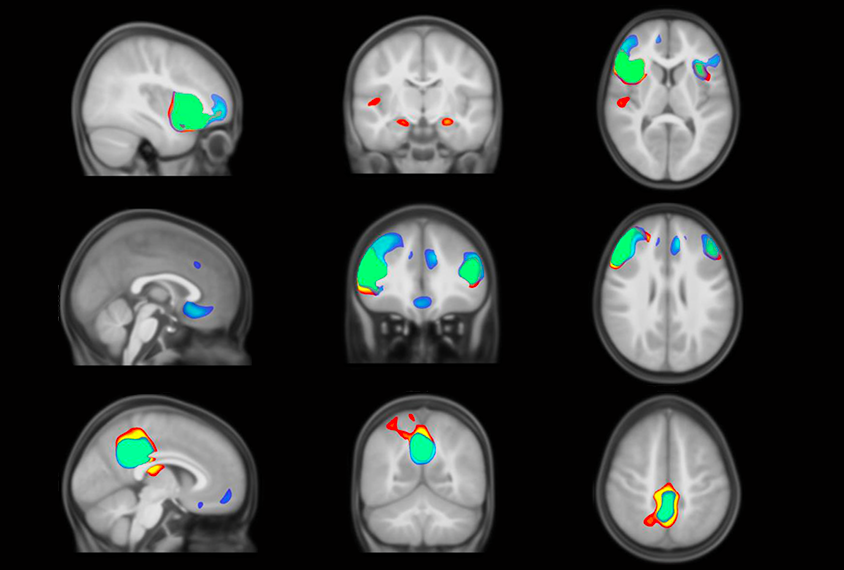
This study found differences between 3 year old autistic males and females in three networks that have been widely implicated in autism.


Our research program is part of
the UC Davis MIND Institute

Recent Talks & Presentations

  • Why autism brain studies matter
  • Women and Girls on the Spectrum (30 min)
  • Gender Diversity in Autism & the NeuroTeens Support Group
  • Science Minds (18 min)
  • Understanding and Supporting the Intersections Between Neurodiversity and Gender Nonconformity (1 hr)

Featured Publications

  • Autism, Big Brains, and Zebrafish?
  • Looking at gastrointestinal symptoms in autistic children over time
  • Sex differences in trajectories of cortical development in autistic children from 2–13 years of age
  • Why do we need sex-balanced studies of autism?
  • IQ trajectories in autistic children through preadolescence
Copyright © 2026 Nordahl Lab – OnePress theme by FameThemes