Skip to content

Nordahl Lab

Neuroimaging of development in autism | UC Davis MIND Institute

Menu
  • Home
  • Team
    • Faculty
    • Staff
    • Study Coordinators
    • Trainees
  • Studies
  • Publications & Findings
  • Presentations
    • About Dr. Nordahl
    • Autism in girls and women
    • Autism Phenome Project – autism subgroups
    • Gender Diversity in Autism
    • Respectful Language in Autism Research
  • Resources for Families
  • NeuroTeens

2023

Presentations

Gender Diversity in Autism & the NeuroTeens Support Group

Facebook Live (2023) hosted by Christine Wu Nordahl with guests Seven Scripa, Steven Dennison, and Mak Soller

Presentations

Science Minds (18 min)

Host Andrew Dakopolos in conversation with Christine Wu Nordahl (2023)
Presentations

Understanding and Supporting the Intersections Between Neurodiversity and Gender Nonconformity (1 hr)

Presentation at the Improving OUTComes for LGBTQ+ Community Health conference (2023) by Josh Lee and Brianna Heath

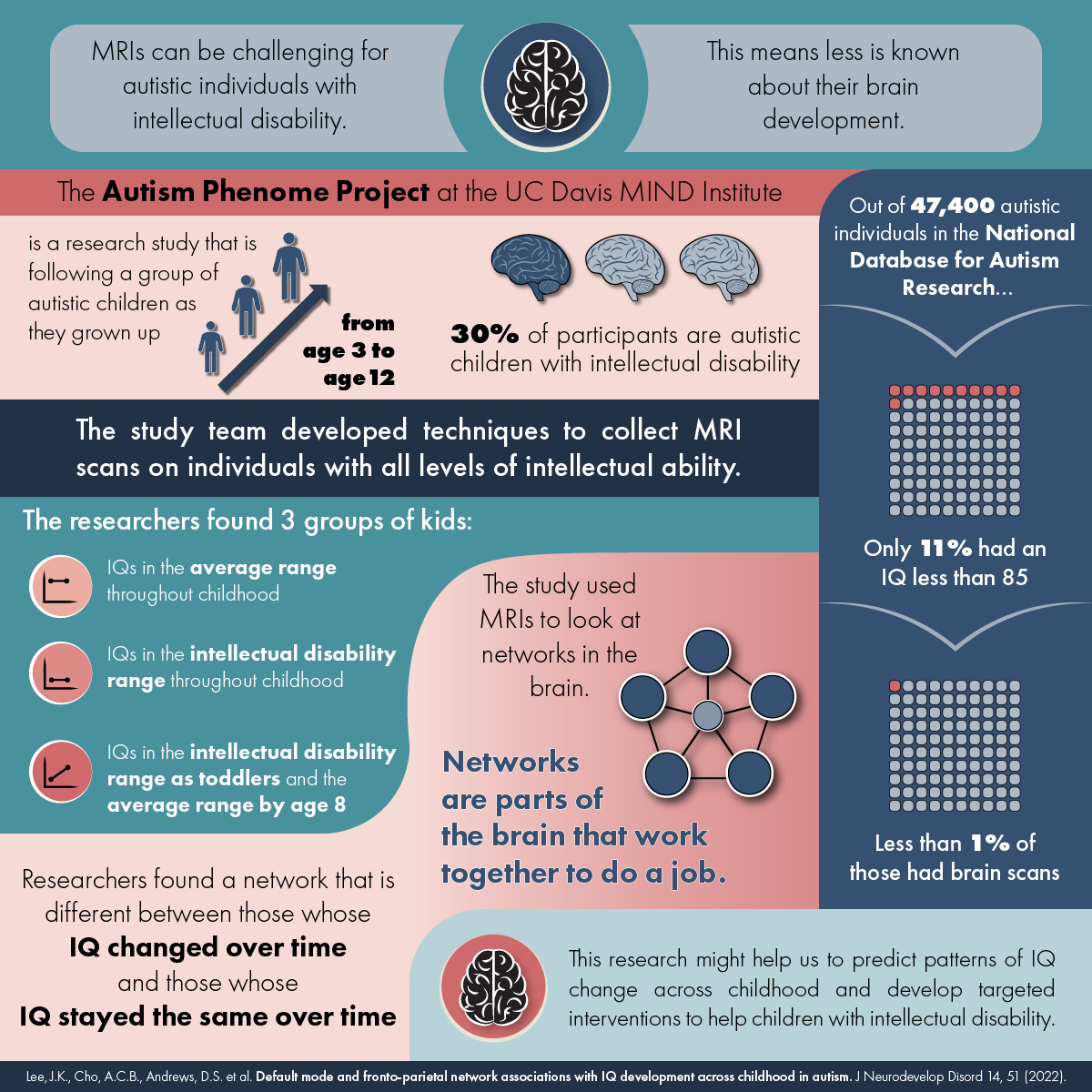
Infographic for the IQ trajectories article. Section 1: MRIs can be challenging for autistic individuals with intellectual disability. This means less is known about their brain development. Section 2: Out of 47,400 autistic individuals in the National Database for Autism Research, only 11% had an IQ less than 85. Less than 1% of those had brain scans. Section 3: The Autism Phenome Project at the UC Davis MIND Institute is a research study that is following a group of autistic children as they grown up from age 3 to age 12 30% of participants are autistic children with intellectual disability. The study team developed techniques to collect MRI scans on individuals with all levels of intellectual ability. Section 4: The researchers found 3 groups of kids: IQs in the average range throughout childhood. IQs in the intellectual disability range throughout childhood. IQs in the intellectual disability range as toddlers and the average range by age 8. Section 5: The study used MRIs to look at networks in the brain. Networks are parts of the brain that work together to do a job. Researchers found a network that is different between those whose IQ changed over time and those whose IQ stayed the same over time. Section 6: This research might help us to predict patterns of IQ change across childhood and develop targeted interventions to help children with intellectual disability.
Featured Publications / Publications

IQ trajectories in autistic children through preadolescence

The study team developed techniques to collect MRI scans on individuals with all levels of intellectual ability. We found a brain network that is different between children whose IQ changed over time and those whose IQ stayed the same over time.


Our research program is part of
the UC Davis MIND Institute

Recent Talks & Presentations

  • Why autism brain studies matter
  • Women and Girls on the Spectrum (30 min)
  • Gender Diversity in Autism & the NeuroTeens Support Group
  • Science Minds (18 min)
  • Understanding and Supporting the Intersections Between Neurodiversity and Gender Nonconformity (1 hr)

Featured Publications

  • Autism, Big Brains, and Zebrafish?
  • Looking at gastrointestinal symptoms in autistic children over time
  • Sex differences in trajectories of cortical development in autistic children from 2–13 years of age
  • Why do we need sex-balanced studies of autism?
  • IQ trajectories in autistic children through preadolescence
Copyright © 2026 Nordahl Lab – OnePress theme by FameThemes